
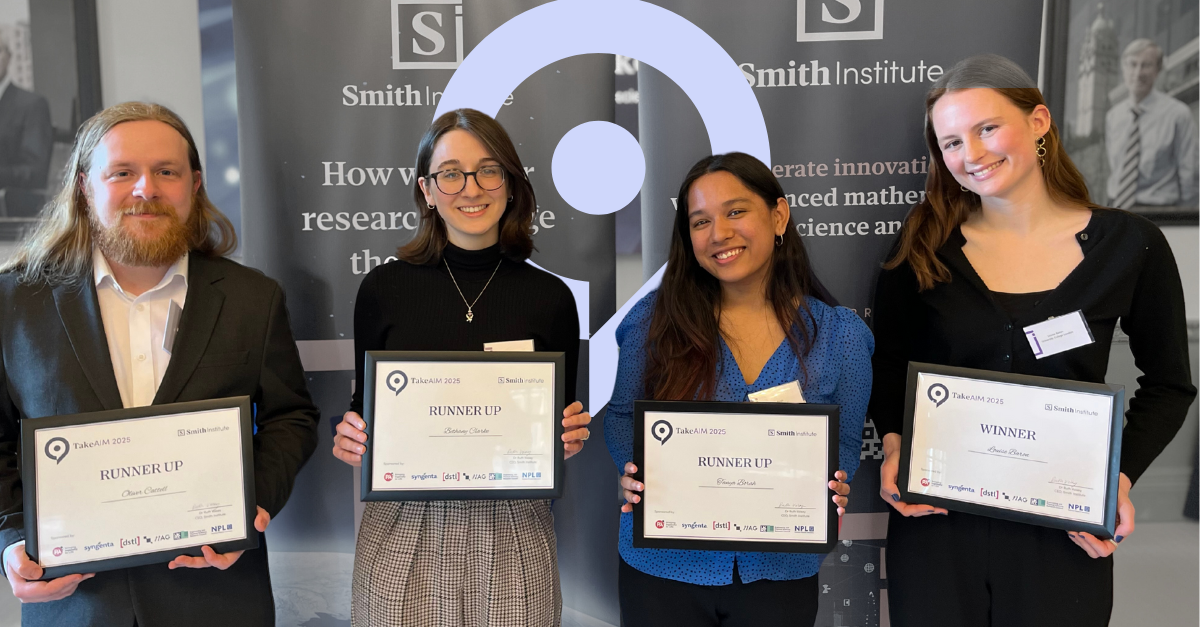




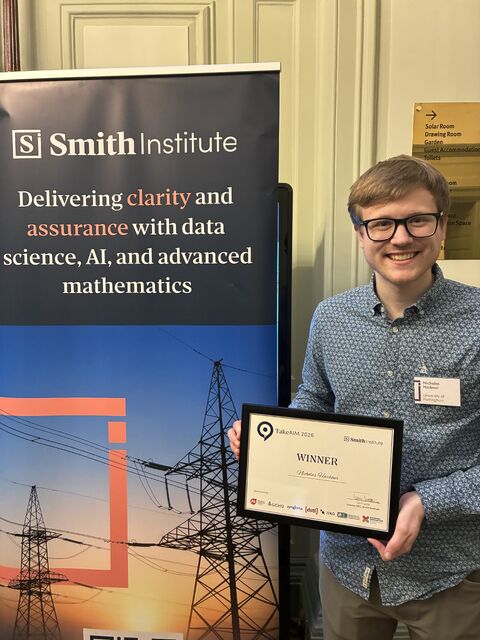

Winner
Nicholas Harbour, The University of Nottingham
Mathematical modeling of glionblastoma: dynamics, therapy and digital twins
Finalist
Microfibre release by washing machines
Finalist
Alkaios Lamprakis, University College London
From guesswork to certainty: predicting spinal fractures in cancer patients
Finalist
Tim Liu, Imperial College London
Physics-aware AI for early disease detection
Winner
Louise Baron, University College London
Harnessing generative AI to transform the diagnosis of Alzheimer’s disease
Finalist
Tanya Borah, University of Oxford (Keble College)
Advancements in deep learning techniques: A custom hybrid optimizer with versatile applications
Finalist
Oliver Cattell, University of Nottingham
Mathematical models of epilepsy and seizure progression
Finalist
Bethany Clarke, Imperial College London
The Beat of Life: Exploring the Role of Cilia
Winner
Kevin Michalewicz, Imperial College London
Neural Networks for Antibody Design
Finalist
Ziyang Yang, University of Lancaster
Smarter, Safer and More Sustainable Internet of Things Monitoring
Finalist
Daniel Stocks, University of Bristol
Mathematical modelling of the humoral response to COVID-19 vaccination
Finalist
Rosie Evans, University of Birmingham
Winner
Eleanor D’Arcy, Lancaster University
Accounting for climate change and seasonality in extreme sea level estimation
Finalist
Alissa Hummer, University of Oxford, St Catherine’s College
Machine learning to accelerate therapeutic antibody development
Finalist
Jennifer Power, University of Bath
Making cancer treatments safer with mathematics
Finalist
Fiona Young, University College London
Winner
Catherine Wells, University of Reading
Tracking the sustainability of long-haul flights
Finalist
Eleanor Russell, University of Manchester
Thermal metamaterials: The future of electronics
Finalist
Markus Dablander, University of Oxford
Small changes with large impacts: Accelerating drug discovery by predicting activity cliffs in chemical space
Finalist
Callum Barltrop, Lancaster University
The importance of combined extreme events for nuclear regulation
Finalist
Sarah Crossland, University of Leeds
The strain of diabetic foot ulceration: Using maths for risk assessment
Winner
Nazia Ahmed, University of Leeds
Using maths to take on the deadliest cancer – glioblastoma
Finalist
Georgia S. Brennan, University of Oxford
40 years of Alzheimer’s disease dynamics in 14 seconds
Finalist
Maria Tatulea-Codrean, University of Cambridge
Know your enemy: Using mathematics to understand the movement of bacteria
Finalist
Benjamin Warmington, University of Bristol
Taking inspiration from nature's smallest machines to inspire better robotics
Winner
Sarah Brown, University of Nottingham
Using maths to combat potentially fatal asthma attacks
Winner
Enrico Gavagnin, University of Bath
A collective human challenge
Finalist
Arkady Wey, University of Oxford
The contamination crisis and a filtration fix
Finalist
Laura Wadkin, Newcastle University
Using mathematics to optimise stem cell experiments
Winner
Emma L Davis, University of Warwick
A zombie apocalypse...?
Finalist
Lisa Koeppel, Lancaster University
Predicting the spread and the risk of dengue
Finalist
Joseph Field, University of Oxford
X-ray reconstruction of moving bodies
Finalist
Adriaan Hilbers, Imperial College London
Keeping the lights on: robust design for decarbonised electricity systems
Finalist
Lisa Maria Kreusser, University of Cambridge
Using mathematics to make our digital world safer
Finalist
Amy Mallinson, University of Manchester
Finding the missing meteorites of Antarctica
Finalist
Maria Tang, University of Cambridge
Modelling the spread of a pandemic
Finalist
Mel Beckerleg, University of Oxford
Filling in the blanks
Oliver Sheridan-Methven, University of Oxford
Accurate answers from imprecise calculations
Winner
Elizabeth Holden, University of Nottingham
Informing tissue engineering design
Finalist
Roxana Pamfil, University of Oxford
Customers like you also bought...
Finalist
William Rowley, University of Manchester
Acoustic metamaterials for noise reduction applications
Finalist
Syed Rezwan Kabir, Heriot Watt University
Advanced machine learning for operational flood forecasting and mapping
Finalist
Kristian Kiradjiev, University of Oxford
Modelling removal of harmful chemicals from flue gas
Finalist
Marco Pietropaoli, Imperial College London
TOffee (Topology optimisation for fluid engineering
Finalist
Federico Danieli, University of Oxford
Chasing the sun
Finalist
Helen Fletcher, University of Oxford
Modelling the next generation of batteries
Office Address:
Willow Court, West Way, Minns
Business Park. Oxford OX2 0JB
hello@smithinst.co.uk




Quality Policy | IT Security | Health and Safety Policy | Environment Policy | Business Continuity | Privacy Policy | This website uses cookies | Terms of Use
© Smith Institute 2026. All rights reserved. Website by Studio Global
Smith Institute Ltd is a company limited by guarantee registered in England & Wales number 03341743 with registered address at 1 Minster Court, Tuscam Way, Camberley, GU15 3YY